Asked by a network engineer, answered in 6 seconds
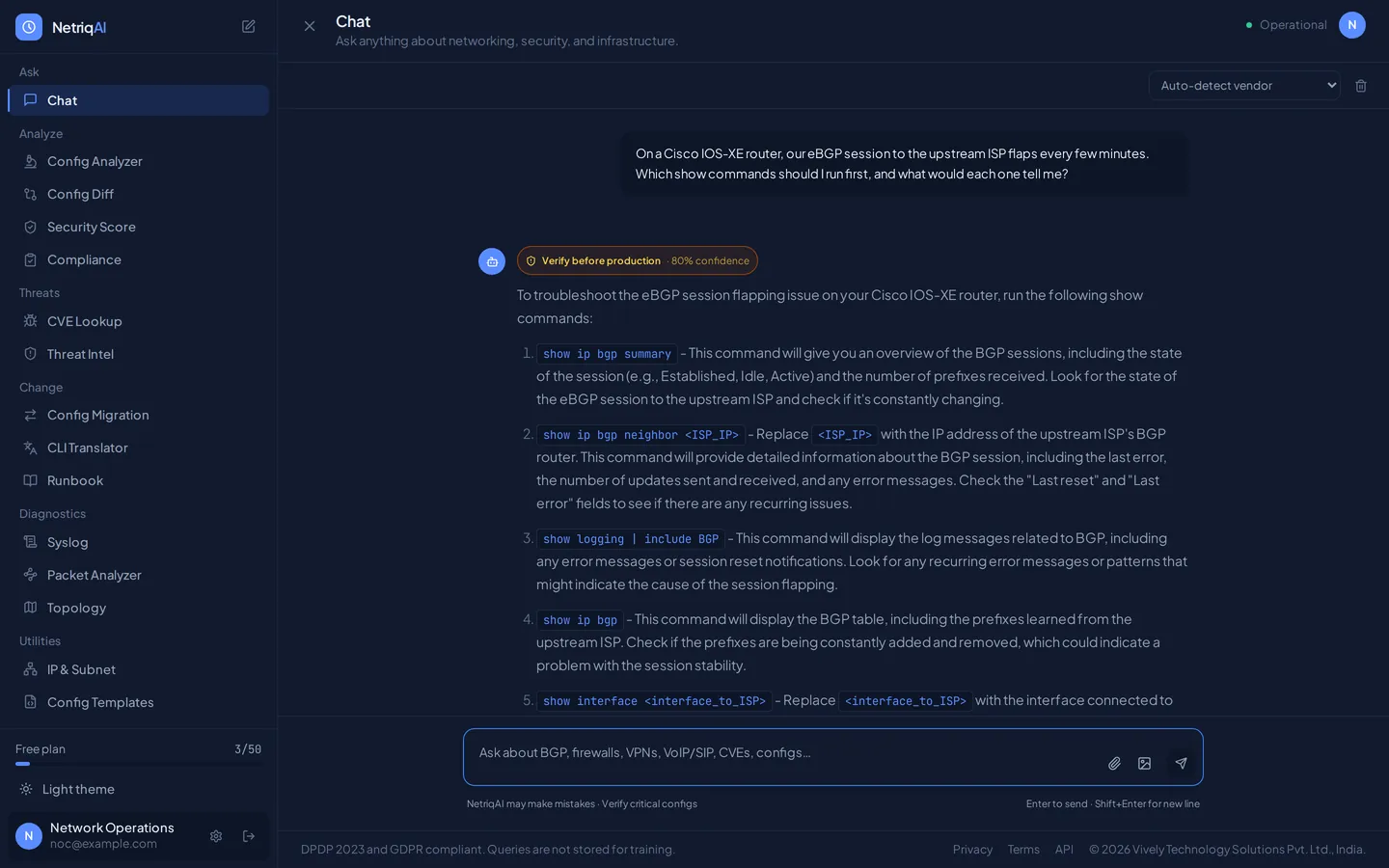
Our eBGP session to the ISP flaps every few minutes. What do I check first?
NetriqAI answers networking and security questions from retrieved, cited sources — and labels what still needs verifying before it reaches a production device.
How an answer is produced
Retrieval first, then reasoning.
A general-purpose model will answer a BGP question confidently whether or not it knows the answer. NetriqAI puts a retrieval and grounding stage in front of the model, and carries the result through to what you read.
-
Classify the question
Query type, vendor, and domain are resolved first, so retrieval is scoped to the right corner of the knowledge base rather than searching everything.
-
Retrieve candidate sources
Semantic vector search and keyword search run together, their results are merged and reranked, and metadata filters keep vendor-specific material with its vendor.
-
Reason over what was retrieved
The model answers with those sources in context. Where retrieval returns nothing relevant, the answer says so instead of inventing detail.
-
Classify the output for safety
Every answer carries a safety label and a confidence figure. Anything that changes device state is marked for verification before production, not presented as tested.
What it does today
Six places to work, not a drawer of tools.
Each workspace is organised by the job you are doing. Everything listed here is built, tested, and running today.
Ask
- Chat
Plain-language questions across networking, security, and infrastructure, answered with sources.
Analyze
- Config Analyzer
- Config Diff
- Security Score
- Compliance
Paste a configuration to find security gaps, compare two versions, score hardening, or map against a standard.
Threats
- CVE Lookup
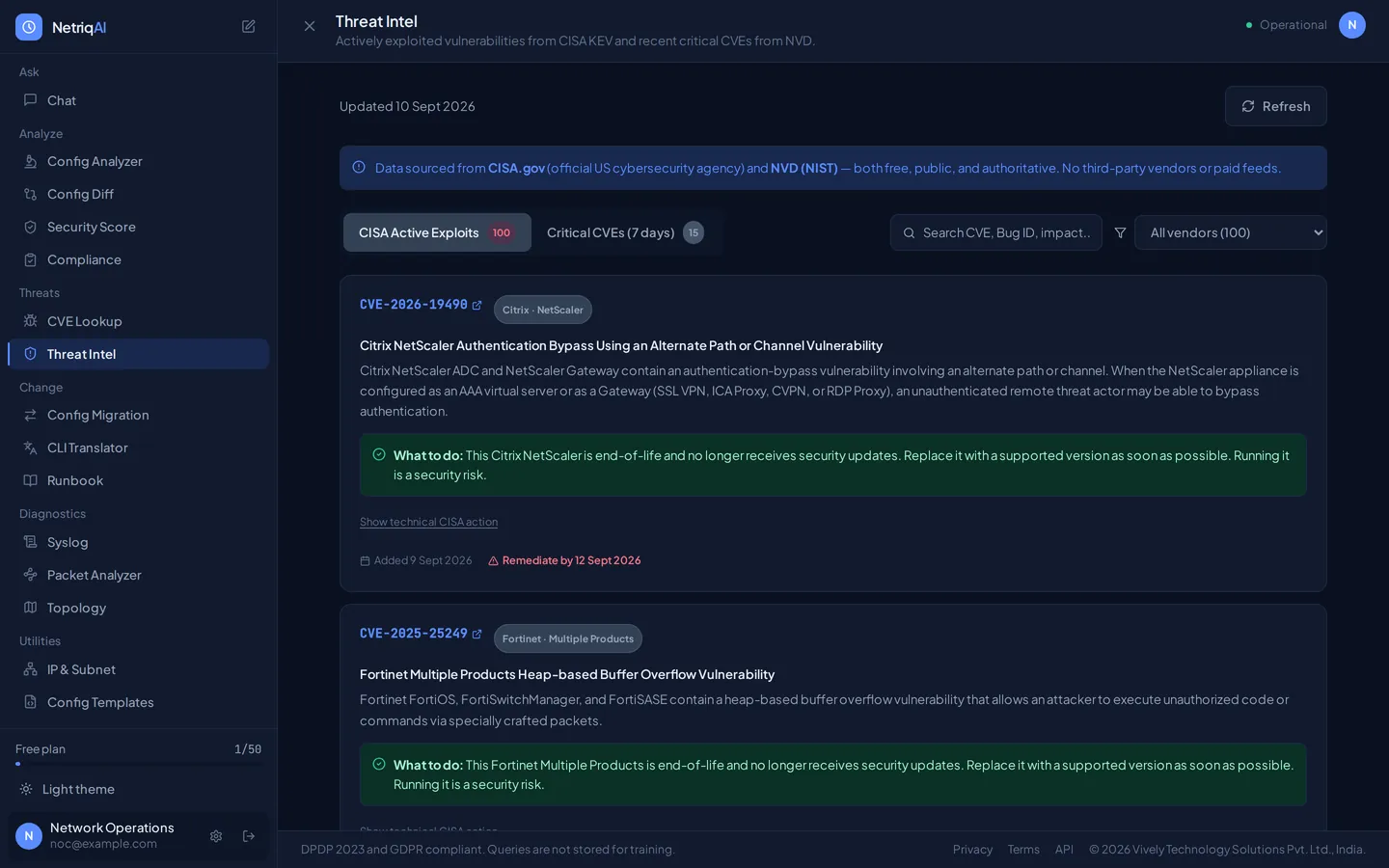
- Threat Intel
CVE detail from NVD, and actively exploited vulnerabilities from the CISA KEV catalogue.
Change
- Config Migration
- CLI Translator
- Runbook
Convert between vendor platforms and draft procedures. Output is a draft to review, never a tested change.
Diagnostics
- Syslog
- Packet Analyzer
- Topology
Paste syslog or tcpdump output for analysis, and draw a network map you maintain yourself.
Utilities
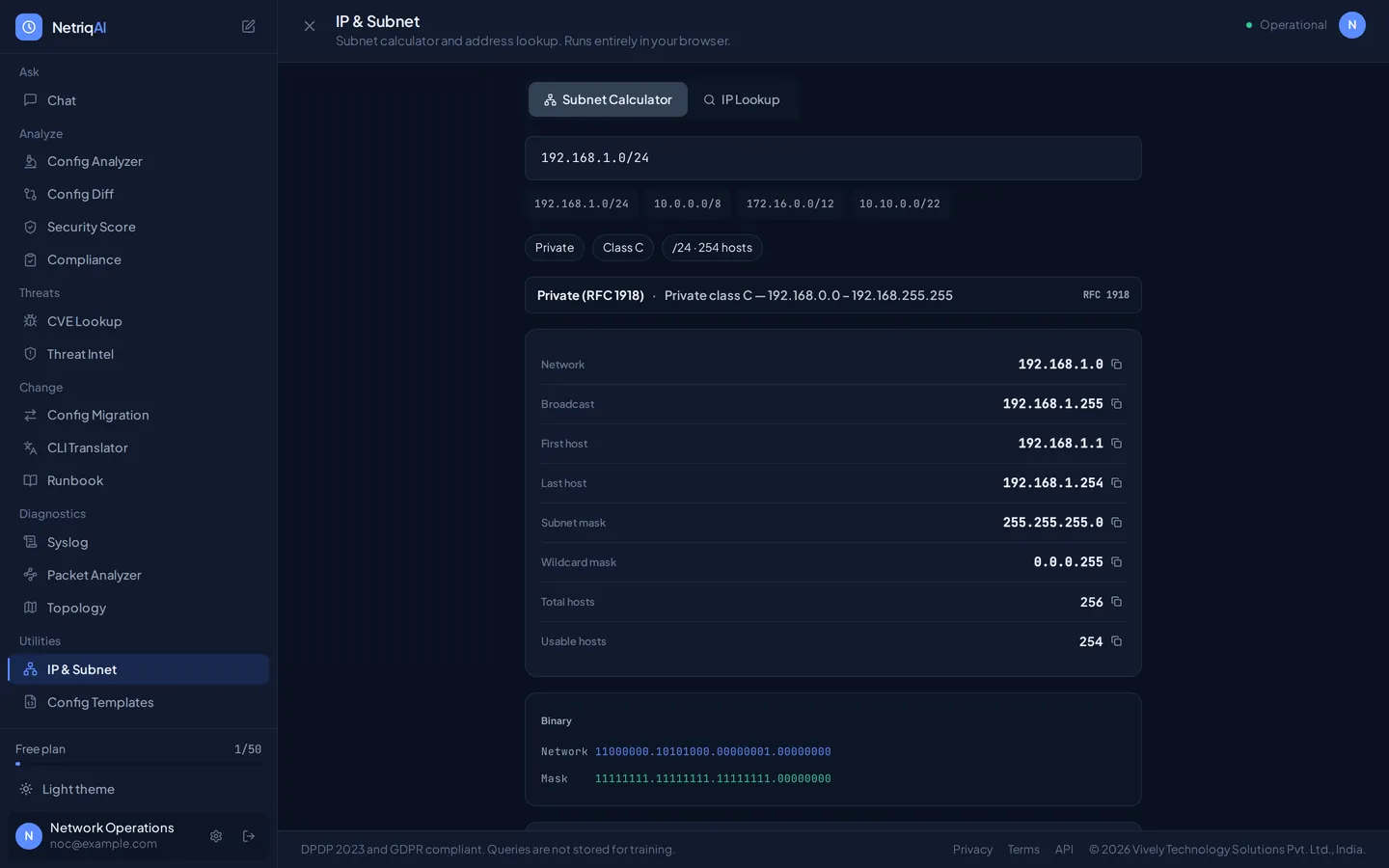
- IP & Subnet
- Config Templates
Subnet maths and address lookup that run entirely in your browser, plus local template storage.
Vulnerabilities that are actually being exploited
Threat Intel reads the CISA Known Exploited Vulnerabilities catalogue and recent critical CVEs from NVD — both public, both authoritative, no third-party feed in between. Each entry states plainly what to do about it.
Compliance gaps with the requirement numbers attached
Map a configuration against PCI-DSS, NIST SP 800-53, CIS Benchmarks, ISO 27001, NIST CSF, or India's DPDP Act. Findings cite the control they come from, so the report is something you can hand to an auditor and defend.

The deterministic things stay deterministic
Subnet maths is arithmetic, not inference. The IP and subnet tools run entirely in your browser, return the same answer every time, and are covered by their own tests — including the awkward cases: /31 point-to-point links, /32 host routes, and masks that are not contiguous.
What is ready, and what is not
We would rather tell you where the edges are.
Plenty of products describe a roadmap in the present tense. This is where NetriqAI actually stands.
Built, tested, and in use. A versioned /v1 API covers chat, config analysis, security scoring, runbooks, CLI translation, CVE lookup and threat intelligence, with per-key rate limits and usage accounting.
Routing, firewalls, VPN and zero-trust material is grounded in authoritative public sources such as NIST and RFCs. Coverage is stronger in some areas than others, and we do not claim comprehensive support for a vendor until its retrieval and answer quality has been measured.
Deep coverage for Cisco Webex Calling, Control Hub, CUCM and CUBE is the next domain pilot. A Model Context Protocol server and a terminal client follow full API certification. None of these are available yet.
A read-only site connector, and later any form of assisted remediation, require explicit customer authorisation and a human approving every change. Today NetriqAI reads only what you paste into it.
Security and privacy
It reads what you paste. Nothing else.
No training on your data
Your queries and configurations are not used to train models. Chat history is encrypted, and account deletion removes your data including API keys and usage records.
No access to your devices
NetriqAI has no path to your infrastructure. It cannot log into a device, push a configuration, or scan a subnet. Everything it knows about your network, you told it.
Answers you can audit
Answers record the sources retrieved and the reasoning path taken, so a surprising result can be traced rather than argued with.
Regulatory posture
Built to India's DPDP Act 2023 and GDPR expectations, with a documented retention period and a deletion path that states exactly what is removed.
Generated change is treated as a draft
Migrations, translated commands and runbooks are labelled for verification. Nothing produced by a model is described as tested on hardware, because it has not been.
Built on Cloudflare
Runs on Cloudflare Workers with data in D1 and Vectorize, served from the edge, with request-level observability.
Ask it something you already know the answer to.
That is the honest way to evaluate a tool like this. Bring a question you have already solved, and see whether the answer holds up — sources, caveats and all.